

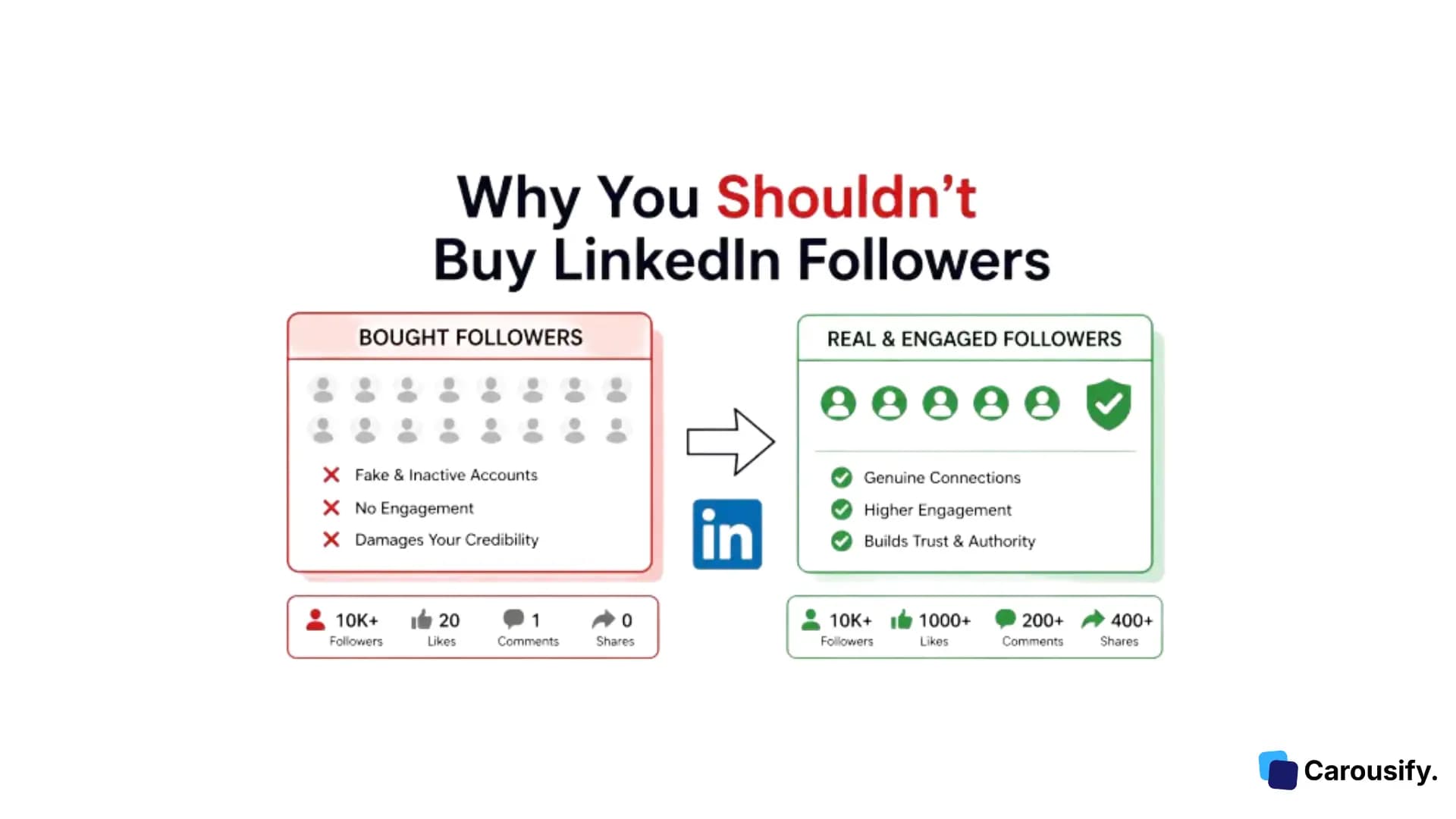
LinkedIn removed 83.7 million fake accounts in just the first half of 2025 — and 97% of them were caught by automated systems before a single user reported a thing.
If you’re thinking about buying LinkedIn followers, that’s the number you should remember. No matter which package you’re looking at, the people selling these followers are selling accounts that LinkedIn’s systems are built to catch and remove. Most of those followers won’t last beyond the next cleanup. The ones that stay will slowly pull down your engagement, and over time your real posts will stop reaching real people.
And in this guide, I'll break down exactly how LinkedIn detects bought followers in 2026, what actually happens to your account when it does, and the organic strategy that's beating bought followers by a wide margin — without the platform risk.
What "Buying LinkedIn Followers" Actually Means
When you pay for followers, you're getting one of three things — all bad:
- Bot accounts — Automated profiles spun up in batches with stock photos and AI-generated names. Cheapest and easiest for LinkedIn to detect.
- Click-farm accounts — Real humans in low-cost regions running dozens of fake profiles. Harder to detect, but still flagged by behavioral patterns.
- Engagement pods — Networks of real users who follow each other for mutual likes. Technically real accounts, but the engagement is fake, and LinkedIn flags them too.
In every case, you're buying numbers. Not customers, not readers, not opportunities. Just a bigger digit next to your name that does nothing for your business.
How LinkedIn's Algorithm Detects Fake Followers (And It's Scary Good)
LinkedIn's anti-fraud team has been tightening the screws since 2023. By 2026, the detection stack is genuinely sophisticated.
Here's what's actually running under the hood:
1. Anomaly Detection Models
LinkedIn's engineering team published a detailed write-up on automated fake account detection covering Isolation Forest models — an unsupervised algorithm that isolates anomalous accounts faster than legitimate ones. And it's been refined for years.
2. AI Profile Picture Detection
LinkedIn deployed a deep learning model that detects 99.6% of AI-generated profile pictures. If your purchased followers share the same synthetic faces or AI-generated images, they'll most likely get flagged before they even land on your list.
3. Follower Velocity Tracking
Sudden spikes clearly indicate something. Suppose, if you go from 400 to 4,000 followers in a week without any engagement rise, it will get noticed quickly, and your posts will be limited right away.
4. Follower-to-Engagement Ratio
The math is very simple: 20,000 followers and 3 likes for each post means fake followers. The algorithm checks this ratio all the time. Once it's off, your reach drops across the board — including with your real audience.
In the first half of 2025, LinkedIn removed 200 million bots and fake accounts. Most of those purges silently delete the followers you paid for, leaving you with the bill and a damaged account.
7 Things That Actually Happen After You Buy Followers
This is where theory meets reality. Here's what you should expect once those followers land on your profile.
1. Your Engagement Rate Tanks
Before writing this post, I tried buying followers for a case study, and after you buy followers, engagement is the first thing that breaks. According to SocialInsider 2026 benchmarks, the engagement rates for personal profiles are 5.20% and buying 2,000 followers on top of your 500 real ones will drop it to 0.2-0.5%.
And the algorithms see that ratio and conclude that your content is bad. Afterwards, their algorithms stop showing your posts to anyone, even the real followers you previously had. This makes it harder for you to re-engage with them!
2. Your Real Followers Get Suspicious
It's not hard for anyone to spot fake followers.
Anyone can open their profile, see their forged work experience, fake profile photos, no activities, empty company fields, etc. Once a real prospect notices these, your credibility is gone — and credibility is the entire reason LinkedIn exists.
3. You Get Hit With Algorithmic Throttling
In the starting phases, LinkedIn rarely bans your account; instead they start with reach throttling.
Your posts go to 5-10% of your audience. Comments get hidden. Connection requests start failing. You're still on the platform, but you're invisible.
4. Your Account Gets Suspended or Permanently Banned
Repeat offenders or accounts with massive purchased growth get the hammer. Studies of flagged profiles suggest a 73% higher suspension rate for accounts caught buying engagement. Once banned, you lose every real connection, endorsement, and message thread you've ever had — not just the fake followers.
5. The Followers Disappear Anyway
LinkedIn's purges run continuously.
Most "follower packages" lose 60-90% of their delivered count within 90 days. So that $50 you spent on 1,000 followers leaves you with 100-400 fake accounts LinkedIn hasn't deleted yet — still tanking your engagement.
6. Your Public Follower Count Crashes Visibly
When LinkedIn does a big purge, it's public. People watch your count drop from 28,000 to 9,000 in a single afternoon. Try recovering from that publicly.
7. You Lose Money Forever
To maintain the inflated count, you have to keep buying. It becomes a subscription where the only thing growing is your spend — and every dollar in is a dollar not going into content or paid ads that actually move the needle.
Buying Followers vs. The Real Cost of Organic Growth
Let me put real numbers next to the comparison.
| Approach | 6-Month Cost | Real Followers Gained | Business Outcome |
|---|---|---|---|
| Buy 5,000 followers | $250-500 | ~500-1,000 (the rest get purged) | Damaged account, low reach, no leads |
| Run LinkedIn ads | $3,000-6,000 | 2,000-4,000 (real, targeted) | Leads, brand awareness, no platform risk |
| Post carousels weekly | $30-60 (tool cost) | 3,000-10,000 (real, niche-aligned) | Inbound leads, authority, trust |
| Hybrid (carousels + light ads) | $1,500-3,000 | 5,000-15,000 (real) | Best ROI long-term |
The cheapest and highest-performing column is consistent organic carousel content. That's not opinion — it's reflected in the engagement data.
What Actually Works
Here's the part that matters.
Skipping the shortcut is only useful if you've got a real path that works. The single biggest unlock for organic LinkedIn growth in 2026 is carousels.
LinkedIn Carousels Are the Highest-Engagement Format
The 2026 numbers are wild:
| Format | Avg. Engagement Rate | vs. Text Posts |
|---|---|---|
| Carousel/Document | 6.60% | +596% |
| Native Video | 3.18% | +189% |
| Image Post | 2.40% | +118% |
| Text Only | 1.10% | Baseline |
| External Link | 0.80% | -27% |
A carousel post pulls 596% more engagement than text posts and 278% more than video. Year-over-year, carousel engagement is up another 14% even as overall organic reach has dropped by 50% across the platform.
Why? Because each swipe is a separate engagement signal. A 10-slide carousel naturally creates 30-60 seconds of dwell time per viewer — exactly the metric LinkedIn rewards hardest now.
How I'd Replace a Bought-Followers Strategy
If I had $250 to spend (the cost of a typical follower package), here's where it'd actually go:
- A Carousify subscription ($14.99/month) — covers 6 months of carousel creation
- One month of LinkedIn Premium ($39) — for profile insights and search visibility
- The rest is in 2-3 small Sponsored Content tests to amplify your best carousels
In the long run, it costs less each month than a single follower package. The followers you get are real people who decide to follow you because they find your content helpful. Those are the followers that compound. The bought ones evaporate.
Frequently Asked Questions (FAQs)
Q: Is buying LinkedIn followers illegal?
It's not illegal, but it directly violates LinkedIn's User Agreement under "Inflating engagement and connections." Penalties range from reach throttling to permanent account bans.
Q: Can LinkedIn really detect bought followers?
Yes - and very reliably.
LinkedIn deleted 200 million fake accounts in 2025. They used machine learning to find fake profile pictures with 99.6% accuracy, unusual follower growth, and the ratio of engagement to followers.
Q: What if I buy "real" followers from a service?
There's no such thing. "Real" follower services either use click farms (real humans paid to follow), engagement pods, or recycled accounts. All are flagged by LinkedIn and provide zero business value.
Q: How long does it take to grow real LinkedIn followers?
With consistent carousel posting (3-5 per week), most creators add 500-2,000 real followers per month after the first 60 days. The growth compounds because real followers drive engagement, which drives reach, which drives more real followers.
Q: Do paid LinkedIn ads count as "buying followers"?
No. Paid ads are an official LinkedIn product reaching real, targeted users. Follower growth from ads is legitimate — just expensive compared to organic carousels.
Summing Up!
Buying LinkedIn followers is the most expensive cheap shortcut on the platform. You spend money to hurt your engagement rate, cause algorithm slowdowns, and risk getting your account banned. Meanwhile, LinkedIn secretly removes the followers you bought.
The format that actually grows accounts in 2026 is carousels. They pull 596% more engagement than text posts, drive real followers, and compound month over month.
Spend your $50 on a few months of Carousify instead of a follower package. In 90 days, you'll have real followers and real engagement. Your profile will actually work for you, instead of being slowed down by an algorithm that's smarter than expected.